Oracle SQL Jumpstart with Examples

Sunday, April 10, 2011
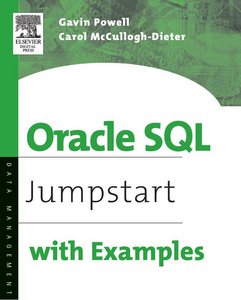


One comes across very few books that make a significant difference in your fundamental understanding of the subject. This is one such book if you want to understand a core database skill SQL. This book deserves a place in your library and you will find it a great reference not only for learning SQL but also for learning data relationships, data organization, data analysis possibilities and so forth. I feel that the title, Oracle SQL: Jumpstart with Examples, might be too simplistic to describe the content. Read on, you will find the real value hidden inside this book." -- Ravi Sharma, Senior Principal Consultant

Developers and DBAs use Oracle SQL coding on a daily basis, whether for application development, finding problems, fine-tuning solutions to those problems, or other critical DBA tasks. Oracle SQL: Jumpstart with Examples is the fastest way to get started and to quickly locate answers to common (and uncommon) questions. It includes all the basic queries: filtering, sorting, operators, conditionals, pseudocolumns, single row functions, joins, grouping and summarizing, grouping functions, subqueries, composite queries, hierarchies, flashback queries, parallel queries, expressions and regular expressions, DML, datatypes (including collections), XML in Oracle, DDL for basic database objects such as tales, views and indexes, Oracle Partitioning, security, and finally PL/SQL.

Features:
* Each of the hundreds of SQL code examples was tested on a working Oracle 10g database
* Invaluable everyday tool that provides an absolute plethora of properly tested examples of Oracle SQL code
* Authors have four decades of commercial experience between them as developers and database administrators

Read more...

Oracle Database 11g DBA Handbook


The Essential Resource for Oracle DBAs--Fully Updated and Expanded

Manage a flexible, highly available Oracle database with help from the expert information contained in this exclusive Oracle Press guide. Fully revised to cover every new feature and utility, Oracle Database 11g DBA Handbook shows how to perform a new installation, upgrade from previous versions, configure hardware and software for maximum efficiency, and employ bulletproof security. You will learn to automate the backup and recovery process, provide transparent failover capability, audit and tune performance, and distribute your enterprise databases with Oracle Net.

* Plan and deploy permanent, temporary, and bigfile tablespaces
* Optimize disk allocation, CPU usage, I/O throughput, and SQL queries
* Develop powerful database management applications
* Guard against human errors using Oracle Flashback and Oracle Automatic Undo Management
* Diagnose and tune system performance using Oracle Automatic Workload Repository and SQL Tuning Sets
* Implement robust security using authentication, authorization, fine-grained auditing, and fine-grained access control
* Maintain high availability using Oracle Real Application Clusters and Oracle Active Data Guard
* Respond more efficiently to failure scenarios by leveraging the Oracle Automatic Diagnostic Repository and the Oracle Repair Advisor
* Back up and restore tables, tablespaces, and databases with Oracle Recovery Manager and Oracle Data Pump Export and Import
* Work with networked databases, data warehouses, and VLDBs
* Put the latest Oracle Database 11g tools to work--Oracle Total Recall, Oracle Flashback Data Archive, and more 

Read more...

The Database Hacker's Handbook: Defending Database Servers


Book Description :
Databases are the nerve center of our economy. Every piece of your personal information is stored there—medical records, bank accounts, employment history, pensions, car registrations, even your children's grades and what groceries you buy. Database attacks are potentially crippling—and relentless.
In this essential follow-up to The Shellcoder's Handbook, four of the world's top security experts teach you to break into and defend the seven most popular database servers. You'll learn how to identify vulnerabilities, how attacks are carried out, and how to stop the carnage. The bad guys already know all this. You need to know it too.

* Identify and plug the new holes in Oracle and Microsoft® SQL Server
* Learn the best defenses for IBM's DB2®, PostgreSQL, Sybase ASE, and MySQL® servers
* Discover how buffer overflow exploitation, privilege escalation through SQL, stored procedure or trigger abuse, and SQL injection enable hacker access
* Recognize vulnerabilities peculiar to each database
* Find out what the attackers already know


Table Of Contents :

Part I, Introduction
Chapter 1, Why Care About Database Security?
Part II, Oracle
Chapter 2, The Oracle Architecture
Chapter 3, Attacking Oracle
Chapter 4, Oracle: Moving Further into the Network
Chapter 5, Securing Oracle
Part III, DB2
Chapter 6, IBM DB2 Universal Database
Chapter 7, DB2: Discovery, Attack, and Defense
Chapter 8, Attacking DB2
Chapter 9, Securing DB2
Part IV, Informix
Chapter 10, The Informix Architecture
Chapter 11, Informix: Discovery, Attack, and Defense
Chapter 12, Securing Informix
Part V, Sybase ASE
Chapter 13, The Sybase Architecture
Chapter 14, Sybase: Discovery, Attack, and Defense
Chapter 15, Sybase: Moving Further into the Network
Chapter 16, Securing Sybase
Part VI, MySQL
Chapter 17, MySQL Architecture
Chapter 18, MySQL: Discovery, Attack, and Defense
Chapter 19, MySQL: Moving Further into the Network
Chapter 20, Securing MySQL
Part VII, SQL Server
Chapter 21, Microsoft SQL Server Architecture
Chapter 22, SQL Server: Exploitation, Attack, and Defense
Chapter 23, Securing SQL Server
Part VIII, PostgreSQL
Chapter 24, The PostgreSQL Architecture
Chapter 25, PostgreSQL: Discovery and Attack
Chapter 26, Securing PostgreSQL
Appendix A, Example C Code for a Time-Delay SQL Injection Harness
Appendix B, Dangerous Extended Stored Procedures
Appendix C, Oracle Default Usernames and Passwords

Read more...

Microsoft SQL Server 2008 Administration for Oracle DBAs


Leverage your Oracle DBA skills on Microsoft SQL Server 2008

Microsoft SQL Server 2008 Administration for Oracle DBAs shows you how to use your experience as an Oracle DBA to get up to speed quickly on the Microsoft SQL Server platform. Authors with real-world expertise in both Oracle and SQL Server introduce you to fundamental concepts, such as SQL Server architecture and core administration, before guiding you through advanced techniques, including performance optimization, high availability and disaster recovery. Platform comparisons, on-the-job examples, and answers to questions raised by Oracle DBAs learning the SQL Server environment help build your skills. This practical guide shows you how to:

* Identify the components of the SQL Server platform
* Understand SQL Server architecture
* Install and configure SQL Server software and client components
* Define and manage database objects
* Implement and administer database security
* Monitor, identify, and resolve performance issues
* Design and implement high availability, system backup, and disaster recovery strategies
* Automate SQL Server using built-in scheduling and alerting capabilities
* Import and export data to and from SQL Server and other RDBMS platforms
* Upgrade existing SQL Server installations and migrate Oracle databases to SQL Server

Read more...
Related Posts with Thumbnails

Sponser Links

Followers

Sponser Links

  ©2009-10 | Disclaimer

Back to TOP