Showing posts with label HTML5. Show all posts

Pro JSF and HTML5, 2nd Edition

Sunday, April 20, 2014


Pro JSF and HTML5, 2nd Edition shows you how to leverage the full potential of JavaServer Faces (JSF) and HTML5. This book is for Java developers who aspire to build sophisticated, enterprise-grade web experiences with HTML5-enabled JSF. Written by JSF experts and verified by established community figures, this book will serve as your primary resource, helping you build or integrate well-designed HTML5-enabled JSF components into your rich internet applications.

Pro JSF and HTML5, 2nd Edition starts by giving you a firm grounding in the design principles of component-based frameworks and the basics of JSF. It then details recent advancements in JSF 2.2 that make it friendlier, faster, and more productive than ever before. And it covers HTML5-enabled components, integration with Java EE7 standards, 3rd party component libraries, security, and performance. The book concludes with a real-world application that puts everything you learned into practice.

In this book you’ll learn

Foundational JSF topics such as the component life cycle, framework architecture, managed beans and CDI, expression language, conversion and validation, JSF events and view parameters.
Leveraging new features in JSF 2.2 such as Faces Flow, Resource Library Contracts, and Ajax file uploading.
Developing Advanced HTML5 enabled components in JSF 2.2.
Creating JSF 2.2 applications that utilize Java EE 7 technologies (CDI, JPA 2.1 and EJB 3.2) for bean management, transaction management and persistence.
Building advanced real-world JSF applications with considerations for security, performance, and usability.
If you’re a Java developer interested in the world of component-based frameworks, Pro JSF and HTML5 is for you.

Table of Contents

Chapter 1. JSF Introduction
Chapter 2. JSF Under the Hood—Part 1
Chapter 3. JSF Under the Hood—Part 2
Chapter 4. JSF Under the Hood—Part 3
Chapter 5. JSF 2.2: What’s New?
Chapter 6. Going Deep: JSF Custom Components
Chapter 7. Basic JSF2 HTML5 Components
Chapter 8. Advanced JSF2 HTML5 Components
Chapter 9. JSF Component Libraries
Chapter 10. Creating a Basic JSF 2.2 Application
Chapter 11. JSF2 Advanced Topics
Chapter 12. JSF2 Security and Performance
Chapter 13. Applying It All: The Mega App

Pro JSF and HTML5, 2nd Edition

Read more...

HTML5 And CSS3 For Dummies

Monday, April 14, 2014


Learn to create powerful and unique websites with HTML5 and CSS3
HTML5 and CSS3 have ushered in an entirely new era in web development and web design. This easy-to-understand full-color guide presents the elements of design and development as equal; therefore, both designers and developers will benefit from learning how to leverage the power behind HTML5 and CSS3. The two-page spreads and helpful insight show you how to use HTML5 and CSS3 in conjunction in order to create websites that possess both powerful function and beautiful design.

Incorporates all the trademark elements of the For Dummies series writing style - approachable, friendly, reliable, and functional - to assist you in gaining a solid foundation of the basics
Fills the void for both developers and designers who are looking to merge the power and function of HTML5 and CSS3
Features a website with code and templates
HTML5 and CSS3 For Dummies covers what you need to know to use HTML5 and CSS3, without weighing you down in unnecessary information.

HTML5 And CSS3 For Dummies

Read more...

HTML5 Boilerplate Web Development

Saturday, January 26, 2013


Master Web Development with a robust set of templates to get your projects done quickly and effectively

Overview
Master HTML5 Boilerplate as starting templates for future projects
Learn how to optimize your workflow with HTML5 Boilerplate templates and set up servers optimized for performance
Learn to feature-detect and serve appropriate styles and scripts across browser types

In Detail
HTML5 Boilerplate is the number one choice for many web developers to get their projects going. It provides a comprehensive set of starting templates to get your developments going, ensuring you don't forget any important elements of a typical web project while also ensuring you are writing quality code and mark up. Learning how to use this framework of page and code templates will allow you to kick-start your projects quickly without losing out on quality.

"HTML5 Boilerplate Web Development" will enable you to build new projects effectively with minimal effort. HTML5 Boilerplate allows you to deploy quality websites successfully and quickly while also ensuring robust cross-browser performance. It takes you through the step-by-step process of creating a website and teaches you to take full advantage of the html layouts provided within HTML5 Boilerplate; be it styles, mark up, or code so you can accomplish your goals.

This book will guide you through the process of building a music festival website, as an applicable example, using HTML5 Boilerplate. You will install, set up HTML5 Boilerplate and deploy production sites.

First, we will look at how to install HTML5 Boilerplate so you can use it repeatedly to jumpstart your projects, then we will look at structuring your website using the base files. We will use Modernizr and feature detection to dynamically serve different styles and scripts based on support of certain features. We will discover how to best configure our server to provide high performance and security for our website. Finally, we employ the Build Tool to combine files, remove comments and make the site ready for production use.

"HTML5 Boilerplate Web Development" offers a well-rounded tutorial in expert web development; not just a starting place for web projects. It develops code snippets, links to further resources for and in addition to makes you understand the nuances of HTML5 Boilerplate.

What you will learn from this book
Master the internals of HTML5 Boilerplate
Write code using feature detection that will work in all browsers while providing alternate experiences where necessary
Use a build tool to minimize the cost of deploying your project to production
Maintain good page performance of web pages in your project by choosing the best server defaults
Write end-to-end web projects that are robust and work across browsers by default
Learn how to use HTML5 Boilerplate with CMSs and other language frameworks; such as Wordpress, Django, and more.
Find ways to debug easily and methods of asking for help so you receive quick responses

HTML5 Boilerplate Web Development

Read more...

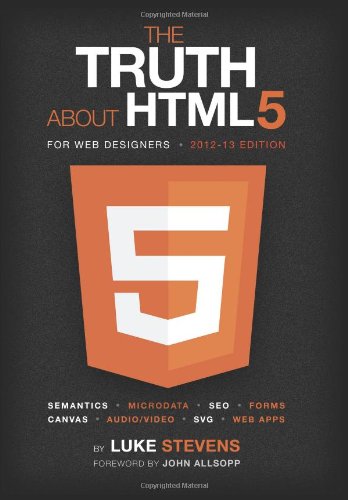
The Truth About HTML5 (For Web Designers)


This is the book for web designers, web developers, and front-end coders who want to get up to speed with HTML5 in 2012. This is the book that isn’t afraid to point out what everyone gets wrong about HTML5’s new markup, so you don’t make the same mistakes. This is the book that will show you what rocks in HTML5 today and what the future holds for interactivity and video now Flash is dying. This is the book that doesn’t think marking up a basic web page should be a quasi-religious exercise where the high priests of HTML5 must be consulted for their interpretation of the holy texts (the HTML5 spec). This is the book that doesn’t pull its punches. This is the book for web professionals who think for themselves. This is the book that tells the truth about HTML5. === 5 Reasons You Should Read The Truth About HTML5 1. Learn HTML5 markup the right way After spending an insane number of hours researching HTML5’s new markup I discovered one disturbing fact: everyone gets it wrong. Really. Don’t waste hours trawling through confusing, poorly researched, and often flat-out wrong blog posts (or books). Get the truth on HTML5’s markup in chapter three and chapter four. 2. Learn about the future of semantics Did you know Google, Yahoo! and Microsoft teamed up in 2011 to launch a new, potentially groundbreaking semantics initiative using HTML5’s new microdata standard? They did, and the new semantics are being used by major sites like eBay and IMDB right now. In chapter seven you’ll be brought up to speed on one of the biggest changes to semantics to ever hit the web. 3. Learn what HTML5 features you can implement today HTML5 isn’t one big blob of technology that will be "finished" at some point in the future. It’s a grab bag of cool stuff, much of which has been around for years. Learn what’s well supported and ready to go today in 2012, including new forms features in chapter eight, and the new audio and video possibilities in chapter ten. 4. Learn what happens when Flash dies The writing is on the wall for Flash. Apple never supported it on mobile; Adobe (Adobe!) have given up on the plug-in for Android; and Microsoft won’t support it in IE10 in the default desktop experience of Windows 8. (Let that sink in for a moment.) Clients will demand HTML5 equivalents of what was done with Flash so we’ll look at what HTML’s Canvas can do in chapter nine and what HTML5 video can (and can’t) do in chapter ten. 5. HTML5 for CMSs, and beyond HTML5 Finally in chapter twelve we’ll look at some of the web app oriented features of HTML5, one of which (the History API) changes something as fundamental as a page refresh. We’ll also touch on features that we should be demanding asking politely to be included in our CMSs, and we’ll look briefly at some post-HTML5 web standards development for mobile that’s becoming a reality right now.

The Truth About HTML5 For Web Designers

Read more...
Related Posts with Thumbnails

Sponser Links

Followers

Sponser Links

  ©2009-10 | Disclaimer

Back to TOP